Palisade gates can be reviewed for custom dimensions, leaf arrangements, infill, finishes and hardware, but the final configuration needs an agreed drawing. For importers, fencing distributors and project buyers, a useful enquiry starts with the required clear opening, site layout and supply scope—not just a nominal gate width. This guide explains how to turn those requirements into a comparable manufacturing quotation.
Can palisade gates be customised for security and appearance?
Yes. KUNYU accepts enquiries for steel palisade gates with project-specific widths, heights, leaf arrangements, opening directions and finishes. Each request is reviewed against the quantity, drawing and proposed components before the order specification is confirmed. A catalogue option is a starting point, rather than approval for every site.
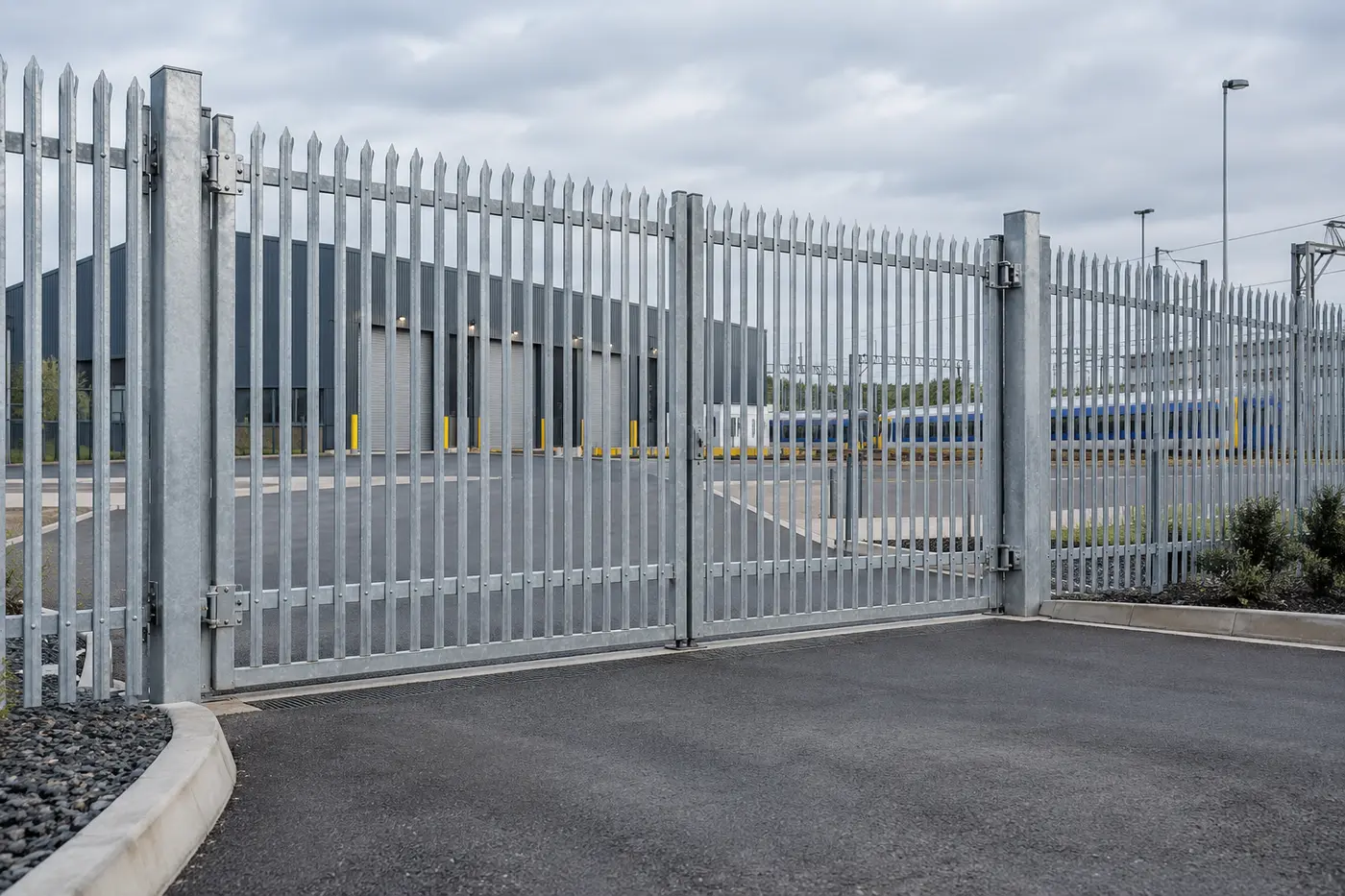
Appearance choices include the colour reference, pale alignment and finish. Functional choices include the frame, posts, hinges, latch or lock and the connection to adjoining fencing. Specify the coating system separately from its colour. W-section or D-section describes a pale profile; neither profile, a pointed head nor a heavier component alone establishes a tested security rating.
Choose the access arrangement before choosing a nominal width
Start with who or what must pass through the opening, the available swing area and the adjoining fence layout. Give pedestrian and vehicle access separate lines in the gate schedule. The examples below are procurement comparisons, not structural sizing or installation instructions.
| Arrangement | When to assess it | What the buyer should confirm |
|---|---|---|
| Pedestrian gate | A separate route for people alongside the boundary or vehicle entrance. | Required clear passage, handing, latch or lock, opening direction and access requirements. |
| Single-leaf swing gate | An opening where the site can accommodate the specified leaf movement. | Leaf sweep, support arrangement, usable opening and clearances throughout movement. |
| Double-leaf swing gate | Vehicle access where a two-leaf arrangement fits the site layout. | Equal or unequal leaves, active leaf, meeting detail, stops, drop bolts and both swing areas. |
Keep clear opening, leaf width and overall width separate
Clear opening is the usable passage through the completed gate arrangement. Leaf width is the dimension of a moving gate leaf. Overall outside-post width includes the gate posts. Post spacing is another dimension that must be labelled on the drawing. Hardware positions and the open leaf can affect the usable passage, so these dimensions cannot be substituted for one another.
KUNYU’s pedestrian gate page lists a nominal 1.2 m reference; the vehicle range lists nominal 4 m, 5 m and 6 m references. These are catalogue references, not guaranteed clear openings. The published gate specifications list 2.0 mm W-section steel pales and dig-in post mounting; frame sections, post details, foundations and the final dimension chain require confirmation for the chosen order.
Worked enquiry example: a required 5,000 mm clear opening
This illustrative brief shows how to describe a requirement using the existing 5 m vehicle-gate range as a discussion point. It is not a completed order, an approved gate design or a promise that a nominal 5 m catalogue gate provides 5,000 mm of usable passage.
If the project requires 5,000 mm of clear vehicle passage, state that explicitly. Ask the supplier to return a drawing showing the usable opening, each leaf, hardware clearances, post positions and overall width. Do not order two 2,500 mm leaves by dividing the requested opening in half: the leaf dimensions must be resolved with the actual frame and hardware geometry.
| RFQ field | Example buyer instruction | Required confirmation |
|---|---|---|
| Gate identification | VG-01: double-leaf vehicle entrance; quantity to be supplied by buyer. | Separate quantities and configurations for every gate ID. |
| Controlling dimension | Required usable clear opening: 5,000 mm. | Supplier drawing labels clear passage, post spacing and outside-post width. |
| Height and infill | Match the specified adjoining steel palisade system; buyer to give height. | Confirm pale section, thickness, head style, spacing and rail alignment. |
| Leaf movement | Buyer to mark inward/outward swing and viewing side on the site sketch. | Confirm handing, leaf split, active leaf and available movement space. |
| Posts and hardware | Itemise posts, hinges, lock/latch, stops and drop bolts. | Identify included items and local works separately. |
| Approval | Provide a numbered drawing revision for review. | Resolve open fields before approval and manufacture. |
Match the gate to the fence and site interfaces
For a new boundary, coordinate the gate posts and adjoining fence connections on the same layout. For replacement work, send photographs and actual measurements of the existing posts, rails, fixing holes and levels. Similar-looking palisade systems are not automatically interchangeable.
Record the ground levels and any obstruction within the intended leaf movement. The responsible project team should confirm the foundation design and site suitability. If automation is required, identify who supplies the drive and controls and who designs, installs and commissions the complete system; a gate manufacturing quotation does not establish those responsibilities.
Compare complete gate quotations on one drawing revision
To compare durable and affordable palisade gates, ask each supplier to price the same approved requirements. A leaf-only price cannot be compared directly with a gate set that includes posts, hinges and locking hardware. Assess durability using the agreed materials, coating specification and relevant inspection records, rather than colour or photographs alone.
For UK and South African buyers, distinguish locally stocked or installed supply from a planned China-based manufacturing and export order. Compare the confirmed quantity, goods-ready timing, packing, delivery point and local work separately. Minimum order quantities, mixed-order acceptance and production dates must be confirmed for the selected specification.
- Use the same gate IDs, quantities, dimension definitions and drawing revision.
- Itemise leaves, posts, hinges, locking hardware, stops, fixings and any agreed spare parts.
- Specify the coating system, colour reference and inspection criteria.
- Request packing dimensions and weights for the actual order before comparing freight.
- State currency, quotation validity, payment milestones, delivery term and all exclusions.
Agree the inspection and handover documents
Before placing the order, identify which dimensions and components will be checked against the approved drawing and how the results will be recorded. Request traceable records for the relevant order where required. A supplier assessment concerns the assessed business and scope; it does not replace product-specific test evidence.
At handover, match package labels to gate IDs and obtain the final component list and drawing revision. Keep any outstanding local installation, foundations or commissioning responsibilities visible in the order documents. Do not treat a catalogue photograph as proof of the exact supplied configuration.
Prepare your custom palisade gate enquiry
Download the gate RFQ schedule and complete one entry for each gate type. Add a site sketch, required clear opening, height, leaf arrangement, finish, quantities, destination and target site date. Mark unknown fields for review instead of filling them with assumed dimensions.
Use the related product links to choose the nearest pedestrian or vehicle-gate reference, then send the completed schedule to KUNYU. We can review the manufacturing and export supply scope against your requested configuration; the final quotation and approved drawing define the order.
Specifications & supporting information
Product figures in this guide refer to the linked KUNYU specifications. Confirm the final configuration and commercial terms in your quotation and approved order documents.
Behind the guide
About KUNYU PERIMETER
KUNYU PERIMETER supplies complete perimeter fencing systems and components for importers, distributors and project buyers. Manufacturing and export supply are coordinated through Zhejiang Kunyu Wiremesh Co., Ltd. and associated manufacturing operations in China.