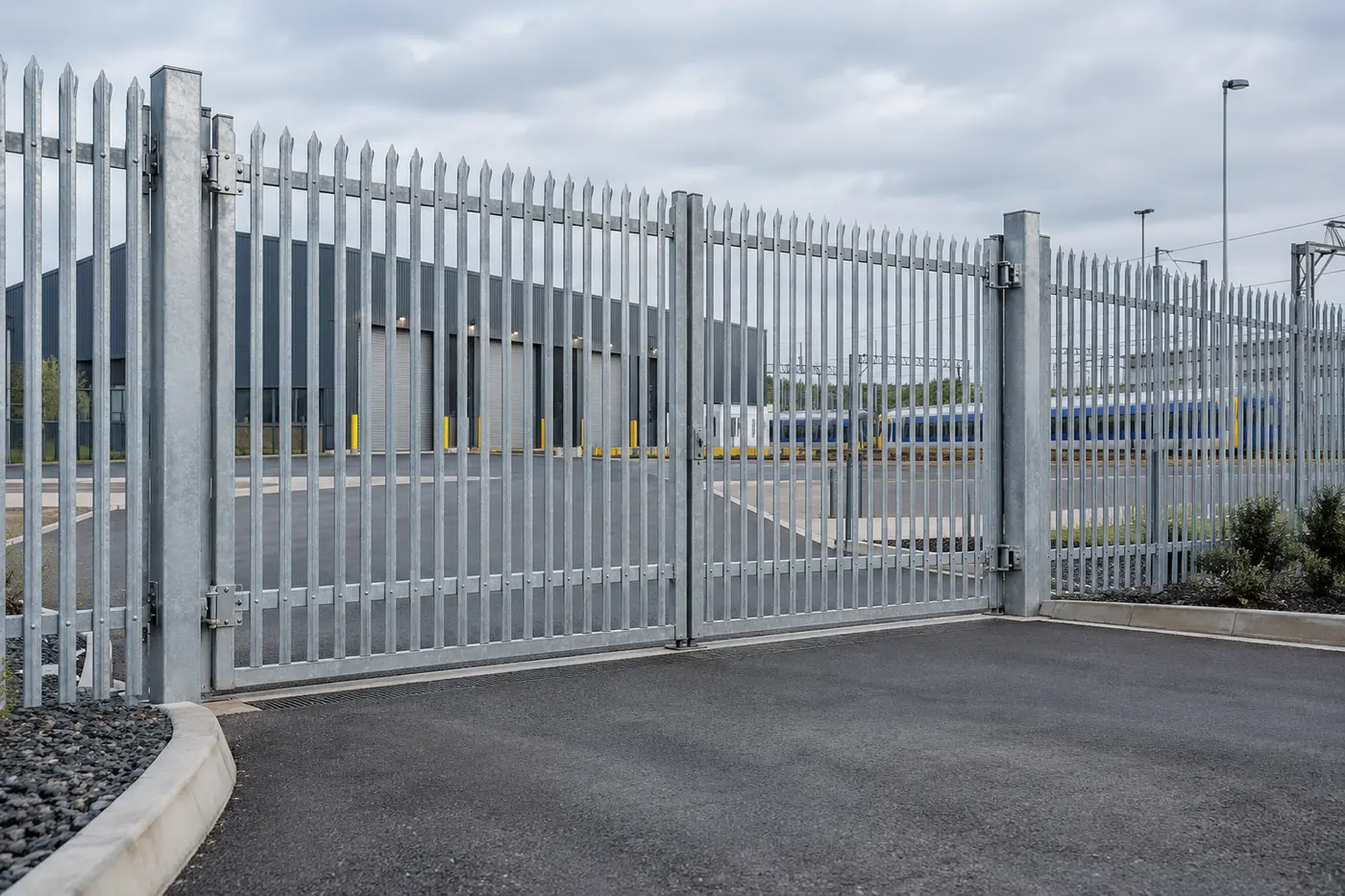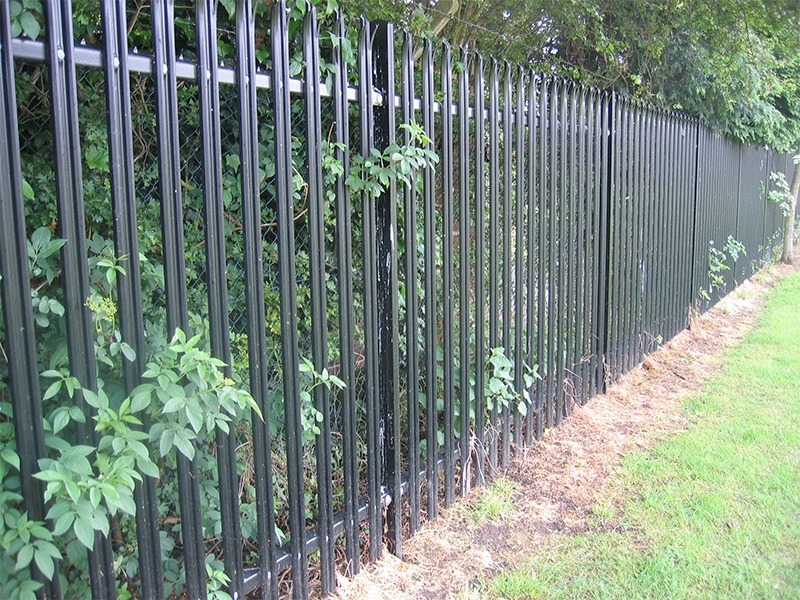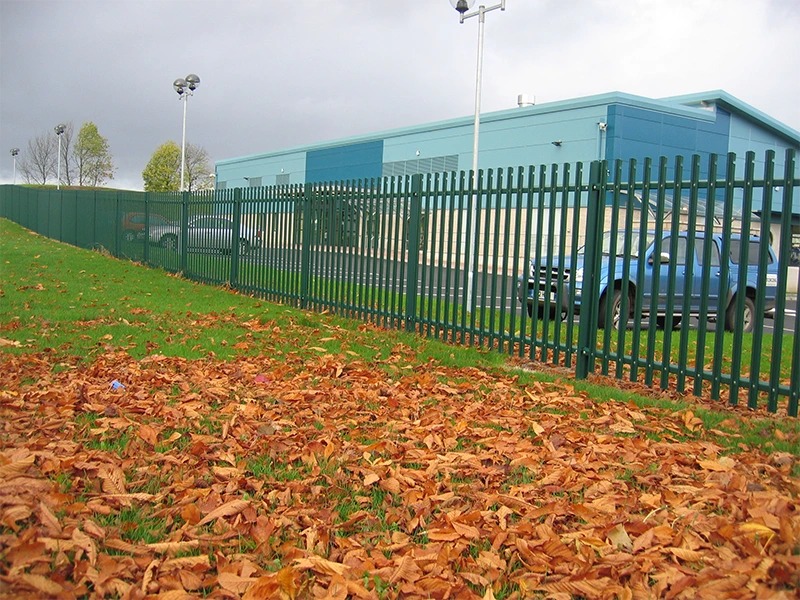

Security fencing types differ in panel construction, visibility, support details and their suitability for a project brief. Compare palisade, 358 mesh, twin-wire and V-mesh systems using the same boundary and access requirements. Product names alone do not establish a tested security rating.
Compare the main security fencing types
Palisade, 358 close mesh, twin-wire and V-mesh fences use different infill constructions. Select against the site task: boundary definition, restricted access, visibility, gate operation and any specified tested performance. A family name alone is not a security rating.
| Type | Construction | Important specification inputs | Visibility considerations | Typical selection context |
|---|---|---|---|---|
| Steel palisade | Separate vertical pales on rails | Profile, thickness, head, posts and connections | Gaps between pales; sightlines depend on profile, spacing and viewing angle | Industrial boundaries and storage compounds |
| 358 close mesh | Closely spaced welded wires | 76.2 × 12.7 mm reference mesh; panel and clamp schedule | Close mesh; check camera and oblique sightlines for the selected layout | Restricted industrial and utility boundaries |
| Twin wire | Two horizontal wires with one vertical wire | 656 / 868 wire designation, aperture and supports | Open welded grid; posts and wire spacing affect views | School, commercial and sports perimeters to project design |
| V mesh | Welded panel with formed folds | Wire, aperture, fold positions and panel dimensions | Open profiled grid; review folds and boundary sightlines | Commercial, school and general site boundaries |
| GRP palisade | Composite pales, rails and posts | Resin/material, section drawings and connection materials | Gaps between composite pales; confirm profile and spacing | Projects specifying composite components and their supporting evidence |
Understanding the mesh descriptions
An 868 panel reference uses two nominal 8 mm horizontal wires and one 6 mm vertical wire. A 656 designation describes a different wire schedule. Specify the aperture and panel dimensions separately from that designation.
V mesh refers to formed panel folds. JB Corrie publishes a V-mesh reference with 5 mm wires and 200 × 50 mm spacing; this is a useful construction comparison, not a universal specification for every V-mesh product.
For a close-mesh option, compare the full 358 system including posts, clamps, overlap and gates. Similar mesh dimensions do not establish that two complete systems have identical tested performance.
Choose by the boundary function
Industrial projects may combine a principal boundary, storage compounds and vehicle gates. Schools need separate consideration of public frontage, restricted areas, pupil routes and sports facilities. Railway or prison projects require the operator or authority specification to be reviewed before manufacture.
A football pitch perimeter, spectator boundary and ball-retention system perform different tasks. Identify the intended function and design loads before choosing a panel or post height. Add razor wire only where it forms part of the authorised project design, with its support schedule defined.
Turn the shortlist into an order schedule
Shortlist systems using the same site layout and access requirements. Request the panel or pale schedule, post sections, connections, finish and required evidence for each option. This gives a meaningful basis for the later price comparison.
Use the product categories for construction details and the application pages for site-specific enquiry inputs. KUNYU can coordinate manufacturing and packing for the approved specification; delivery and installation responsibilities are identified in the quotation.
Common questions
Does a heavier panel always provide better security?
Not by itself. Aperture, supports, fixings, height and the complete tested configuration also matter.
How should I shortlist a fencing type?
Define the boundary function, access needs, visibility, environment and required performance. Compare complete systems against those requirements.
Specifications & supporting information
KUNYU figures refer to the linked product specifications. UK manufacturer references describe comparison configurations, not KUNYU certification or approval. Final dimensions and commercial terms are confirmed in the quotation and approved drawings.
Behind the guide
About KUNYU PERIMETER
KUNYU PERIMETER supplies complete perimeter fencing systems and components for importers, distributors and project buyers. Manufacturing and export supply are coordinated through Zhejiang Kunyu Wiremesh Co., Ltd. and associated manufacturing operations in China.