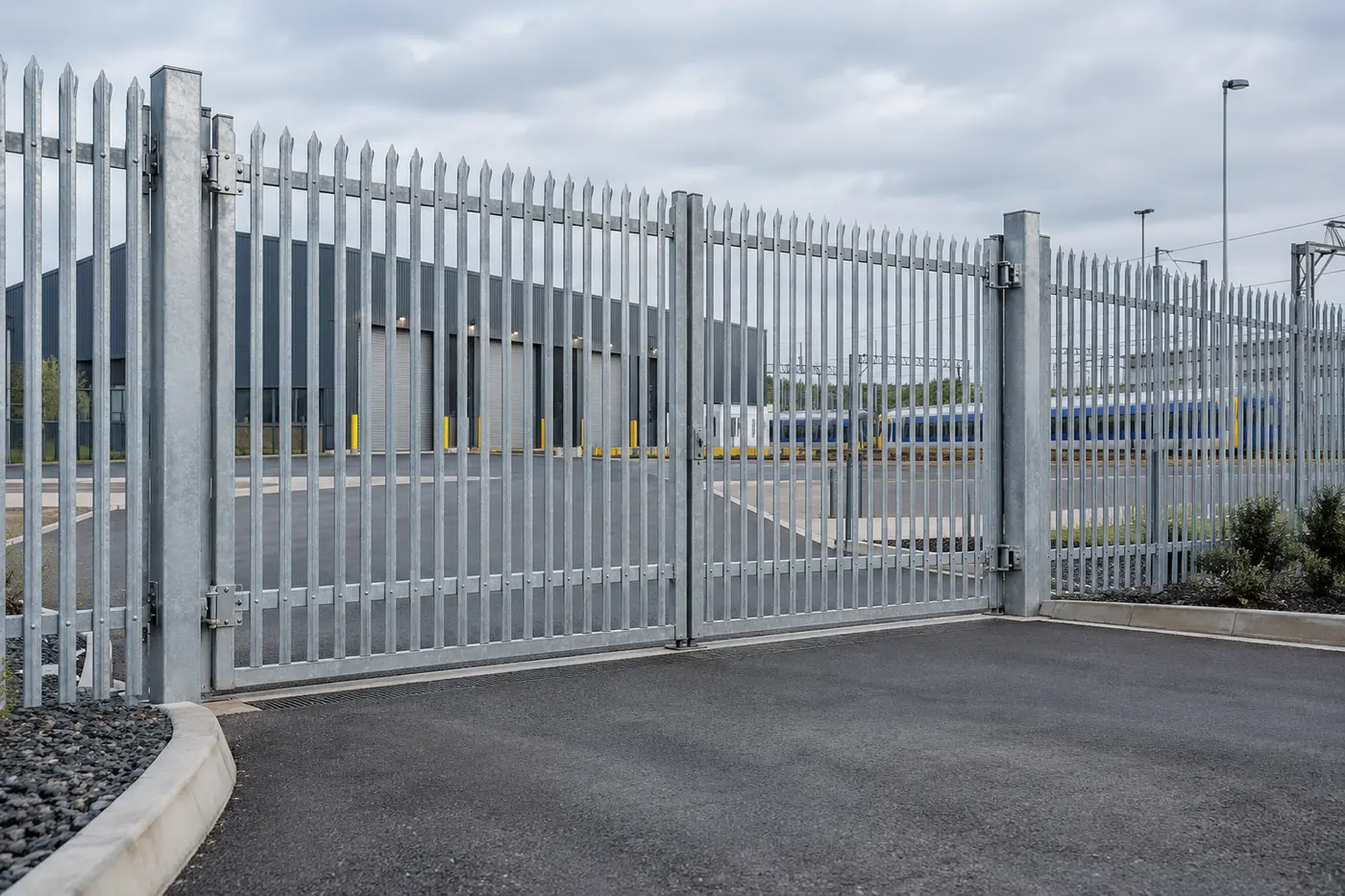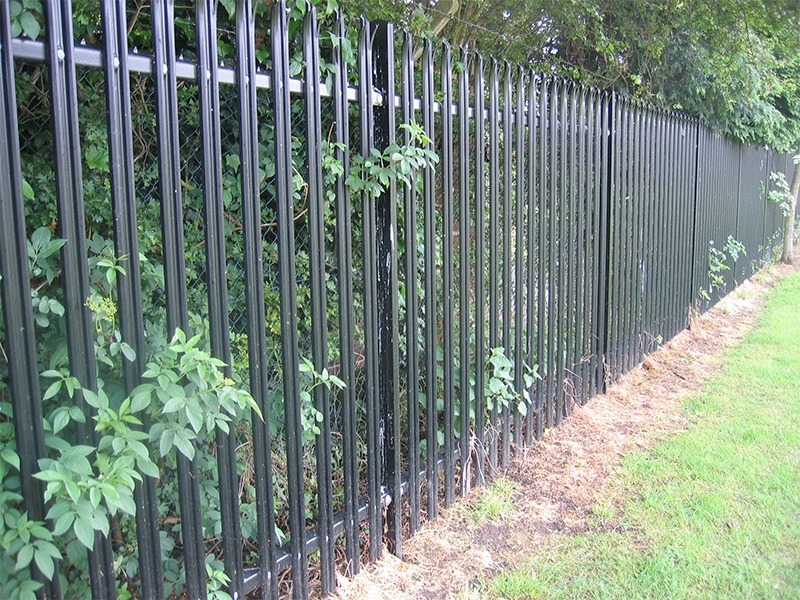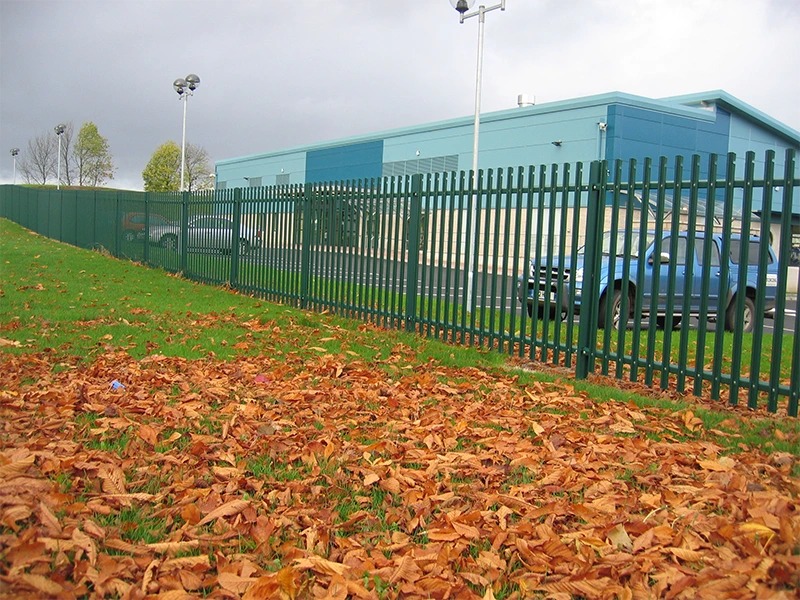

Palisade fencing is a boundary system built from upright pales connected to horizontal rails and posts. Steel versions use specified pale profiles and connections; GRP is a separate material option. The complete system specification determines which components are needed and how they fit together.
How a palisade fence is constructed
Palisade fencing uses individual upright pales joined to horizontal rails and supported by posts. It is a component system: the pale profile, rail connections and post arrangement determine how a complete bay is assembled.
Steel and glass-reinforced plastic (GRP) palisade are separate material choices. Do not use a steel pale specification for a GRP order or assume that their connections and performance evidence are interchangeable.
| Component | Function | Ordering detail |
|---|---|---|
| Pales | Form the upright boundary infill | Material, profile, thickness, length and head |
| Rails | Connect pales across each bay | Section, length, holes and connections |
| Posts | Support fence runs and changes in direction | Section, centres, mounting and end/corner positions |
| Fixings | Join pales, rails and posts | Sizes, materials, quantities and connection drawing |
What W-section and D-section mean
W-section and D-section describe the shape of a steel pale. They do not specify its thickness, head form, coating or complete fence strength. Use a section drawing when comparing offers, particularly for replacement components.
The KUNYU standard W-section reference uses 17 pales and a nominal 2.75 m post-centre module. Its published heights include 1.8, 2.0 and 2.4 m. Treat these as a selected product configuration, not dimensions shared by every palisade system.
Steel and GRP options
Steel systems can be specified with galvanised or galvanised and powder-coated finishes. Define the substrate, coating requirements and colour alongside the component geometry. Matching a colour name does not confirm a matching coating system.
GRP systems use their own material and connection specifications. A UK reference configuration from Captrad uses GRP pales, rails and posts with stainless-steel fixings. Electrical, fire or mechanical performance must be checked for the actual offered configuration rather than inferred from the word GRP.
Where to start an enquiry
First identify the boundary purpose and gate requirements. Then select the material and pale construction, confirm heights and run lengths, and schedule corners, ends and changes in level. The resulting component list is more useful than a request for a number of generic panels.
For product selection, open the palisade category and compare the individual systems. For a component bay, use the standard W-section page; for a different material, open the GRP page. Send the selected specification and layout to request coordinated manufacture and supply.
Common questions
What parts make up a palisade fence?
A typical system uses vertical pales, horizontal rails, posts and connections. The exact component arrangement depends on the selected system.
Is all palisade fencing steel?
No. Steel and GRP are different material options and require their own product specifications.
Specifications & supporting information
KUNYU figures refer to the linked product specifications. UK manufacturer references describe comparison configurations, not KUNYU certification or approval. Final dimensions and commercial terms are confirmed in the quotation and approved drawings.
Behind the guide
About KUNYU PERIMETER
KUNYU PERIMETER supplies complete perimeter fencing systems and components for importers, distributors and project buyers. Manufacturing and export supply are coordinated through Zhejiang Kunyu Wiremesh Co., Ltd. and associated manufacturing operations in China.